
Single session (lots 1–55) at 4:00 p.m. CEST
Pre-auction bid deadline: Tuesday, July 14th, 2026, at 2:00 p.m. CEST.
The auction will be held at Via Edmondo De Amicis 36, Milan.
Lots 23 and 50 will be available for viewing by appointment only. For more information, please email modernandcontemporary@krusoart.com
July 6th, hours 10:00 a.m. – 7:00 p.m. CEST
July 7th, hours 10:00 a.m. – 7:00 p.m. CEST
July 8th, hours 10:00 a.m. – 7:00 p.m. CEST
July 9th, hours 10:00 a.m. – 1:00 p.m. CEST
July 10th, hours 10:00 a.m. – 7:00 p.m. CEST
July 13th, hours 10:00 a.m. – 7:00 p.m. CEST
Via Edmondo De Amicis 36, Milan, Italy.
History, materiality, and discard. These are just some of the terms that may be used to encapsulate the artistic diversity characterizing the present catalogue. An exercise in reducing complexity through which the imaginative transition from thematic “islands” to a true “archipelago” no longer seems implausible.
The concept of history—both in its temporal dimension and in terms of artistic significance—emerges through the Futurist experiments of Roberto Marcello Iras Baldessari, represented in the catalogue by the dynamic Motorcyclist Racing and Train + City, both exemplary works reflecting the artist’s investigations into the theme of speed. As Maurizio Scudiero observes, Motorcyclist Racing “[…] displays a more immediate and incisive mark, entirely consistent with the spontaneous nature of the drawing. The Boccioni-inspired ‘lines of force’ (the diagonal lines crossing the image) serve precisely to convey the ‘movement of the object through space […]’.” Train + City, on the other hand, “[…] belongs to the series of studies on speed that Baldessari devoted particularly to the subject of the moving train […] in which emphasis shifts variously between the mechanical aspect, simultaneity, and the ‘social’ dimension (the crowd awaiting the train’s arrival at the station). In this instance, the train is entering the city as it approaches the station […]”. These works are complemented by the Futurist reinterpretations of Ettore Tani, Verossì, Alfredo Gauro Ambrosi, and by the Aeropainting of Vittorio Caproni.
The selection is further enriched by the iconic presence of Giorgio Morandi. The lyricism and compositional simplicity of his work heighten the distinctive sense of estrangement that transforms the everyday through the persistent repetition of the same subject. Felice Casorati, meanwhile, is represented by a work dating to 1939, featuring two nude figures characteristic of his production during that period. Among the great masters, Piero Dorazio occupies a prominent place. In Anarca I, he imbues his characteristic lattice-like structure with a greater sense of openness, animated by a pronounced inner tension generated through a more restrained and refined geometric composition. The work unfolds through four interwoven structures whose chromatic alternation against a dark background, together with their differing inclinations, infuses the composition with heightened dynamism and luminosity.
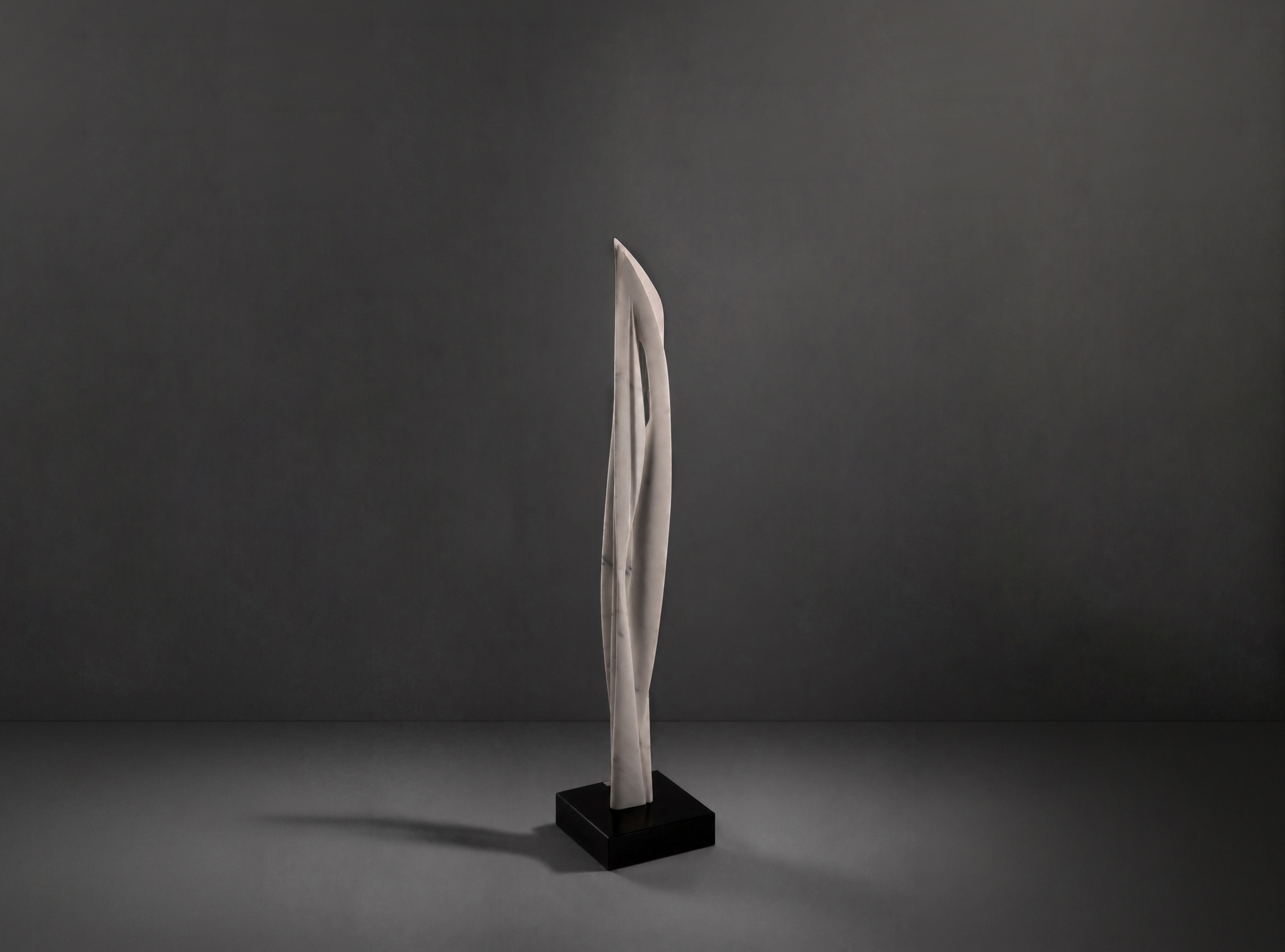
The centrality of materiality is evident in the exceptional craftsmanship of Pablo Atchugarry’s sculpture. The Uruguayan artist has consistently challenged the conventions of the sculptural medium through works that synthesize his primary concern with form, particularly its ascensional and spiritual qualities. Despite their apparent evocations of natural formations, the human body, or architectural structures, Atchugarry’s sculptures invite viewers to move beyond narrative associations, surrendering instead to the sense of mystery inherent in the perfection of form itself. The manual labour embedded within the creative process, together with the constant dialogue between sculpture and light, further liberates these works from the physical weight of their material, intensifying the sense of abstraction and metamorphosis generated by the tension between the tangible solidity of marble and the immaterial purity of light. Marco Tirelli’s sculptural landscapes similarly materialize inner worlds, employing sculpture as an introspective experience, while any emotional inclination is neutralized in the minimalist seriality of Sol LeWitt’s pyramids, shifting attention away from narrative content in favour of a purely perceptual and spatial experience.
Materiality reaches its most radical expression—particularly in terms of scale—through a significant group of works from an important Belgian collection. The works of Sterling Ruby, Sherrie Levine, and Evan Holloway, all leading figures on the international contemporary art scene, reinforce the exhibition’s engagement with the notions of chaos and overproduction that characterize contemporary culture. It is precisely within this framework that the concepts of recovery and the reuse of discarded materials acquire particular significance. Nowhere is this more evident than in the monumental works of Sterling Ruby. ECLPSE (RWYB) appears as a stratification of cardboard sheets originally used by the artist to cover the walls and floors of his studio, subsequently assembled into a composition that celebrates both their formal purity and their evocation of lunar forms and overlapping landscapes. The interplay between chromatic intensity and monumental scale heightens the visual impact of FLAG/RG FACIAL, in which the seemingly random assemblage of materials sourced from the artist’s studio allows the historical traces embedded within each individual element to unfold into a multilayered accumulation of memories and temporalities. This reflection becomes simultaneously darker and more commemorative in REMNANT MEMORIAL, a replica of a bench constructed from the wooden remains of Ruby’s mother’s barn, which, following her death in 2014, was dismantled and shipped from New Freedom, Pennsylvania, to Los Angeles, where the artist lives and works. Adopting a transhistorical approach, Evan Holloway allows the materials employed in Untitled (Large Round Volume with Batteries) and California Ryder to become vehicles for diverse symbols, places, and traditions. While the bitumen used in California Ryder originates directly from the La Brea Tar Pits in Los Angeles, the use of depleted batteries in Untitled (Large Round Volume with Batteries) introduces a global dimension, alluding to the environmental impact of contemporary life. Finally, with Hobbyhorse—a tricycle inspired by William Eggleston’s celebrated photograph—Sherrie Levine dismantles the idyllic imagery of childhood through unsettling contaminations drawn from the adult world, transforming the object into a nostalgic materialization of lost dreams that nevertheless continue to function, for those children now grown, as enduring “hobbyhorses,” both in the literal sense of the title and as cherished personal obsessions.
Auction information:
Jacopo Antolini
Head of Department
jacopo.antolini@krusoart.com
Gabriele Medaglini
Junior Specialist
gabriele.medaglini@krusoart.com
Condition Report
modernandcontemporary@krusoart.com
+39 02 87215920
Pre-auction bids
Gabriele Medaglini
gabriele.medaglini@krusoart.com
+39 02 87215920
Collection of lots:
Alessio Chiaverini
alessio.chiaverini@krusoart.com
+39 02 8721 5920
Il ritiro dei lotti acquistati potrà essere effettuato a partire dal giorno 13 luglio 2026 presso la nostra sede in Via Edmondo De Amicis 36, 20123 Milano, previo appuntamento, scrivendo a logistica@krusoart.com.